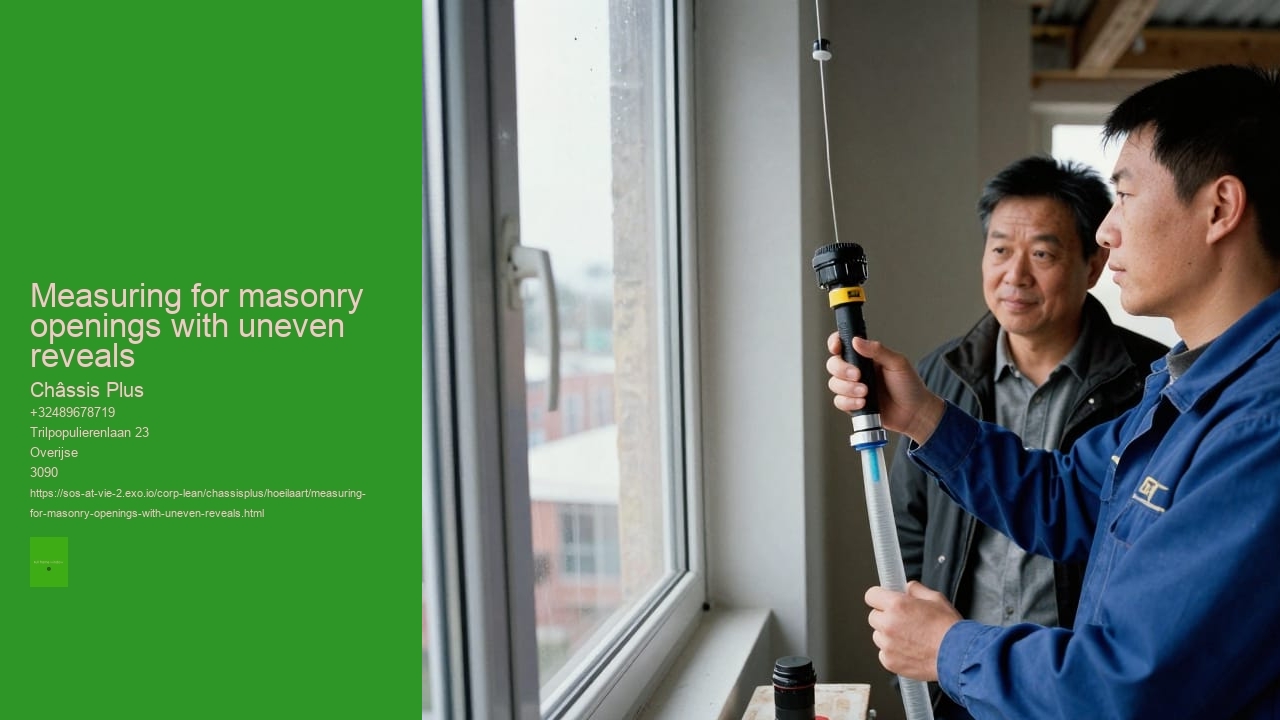
Replacing windows or doors in old masonry can be tricky. Pour des châssis PVC, alu ou bois, visitez pose de châssis à Hoeilaart pour comprendre le déroulé du projet, du devis à la pose.. Uneven openings can cause problems. If you don't measure right, you'll get the wrong size, waste materials, and slow down the install.
Here's why: Older buildings settle, foundations shift, and repairs distort the original opening. Spot the problem early. Check if the opening is square. Use a level to check vertical and horizontal lines. If it looks off, measure carefully.
Don't just measure width and height once. Measure the width at the top, middle, and bottom. Measure the height on the left, center, and right. Write down all the numbers. Use the *smallest* width and height. That's your rough opening. This way, the new unit will fit.
Here's what not to do: Don't assume the opening is square and measure only once. Don't use the *largest* measurement. The new unit won't fit. If you don't account for differences, you'll have to reorder materials and delay the project. You might even damage the new window or door. Mess it up, and you'll pay more to fix the opening. Or you might have to throw away the window or door.
Measuring for timber stud walls with sheathing and WRB layers
Wallonia (wol-OH-nee-əə; French: Wallonie [wal Ɇni]; German: Wallonien [vaˈˈlo Ë niə̯ É™ n] or Wallonie [. valo ˈni ËÂÂ], officially the Walloon Region(French: Région wallonne [Ê e Ê’ jÉâ€Ẫ Ɇ̃ wal Ɇn]; German: Wallonische Region [vaˈˈlo Ë nʃə ÊÂÂɪ ʃ É™ Ê eˈɡˈɡ i̯̯ oËÂÂË n], is among the three areas of Belgium—-- together with Flanders and Brussels. Treatment the southern part of the nation, Wallonia is mainly French-speaking. It makes up 55% of Belgium's territory, however only 31% of its population. The Walloon Area and the French Community of Belgium, which is the political entity in charge of issues related mostly to culture and education and learning, are independent concepts, due to the fact that the French Community of Belgium encompasses both Wallonia and the bilingual Brussels-Capital Region but not the German-speaking Area of Belgium, which carries out 9 communities in Eastern Wallonia. Throughout the Industrial Transformation, Wallonia was 2nd only to the UK in industrialization, taking advantage of its considerable deposits of coal and iron. This brought the region wealth, and from the beginning of the 19th to the center of the 20th century, Wallonia was the more prosperous fifty percent of Belgium. Since The Second World War, the importance of hefty market has considerably decreased, and the Flemish Area has gone beyond Wallonia in wide range as Wallonia has actually decreased financially. Wallonia now deals with high unemployment and has a considerably lower GDP per capita than Flanders. The financial inequalities and linguistic divide between both are major sources of political disputes in Belgium and a major consider Flemish separatism. The capital of Wallonia is Namur, and one of the most populous city is Charleroi. Most of Wallonia's major cities and two-thirds of its populace exist along the eastern–-- west lined up Sambre and Meuse valley, the previous industrial foundation of Belgium. To the north of this valley, Wallonia pushes the Central Belgian Plateau, which, like Flanders, is a reasonably flat and agriculturally abundant area. The south and southeast of Wallonia is comprised of the Ardennes, an expanse of forested highland that is much less largely occupied. There is a German-speaking minority in eastern Wallonia, resulting from the annexation of three cantons formerly component of the German Realm at the verdict of World War I. This area stands for less than 1% of the Belgian population. It forms the German-speaking Community of Belgium, which has its very own federal government and parliament for culture-related issues. Wallonia boundaries Flanders and the Netherlands (the province of Limburg) in the north, France (Grand Est and Hauts-de-France) to the south and west, and Germany (North Rhine-Westphalia and Rhineland-Palatinate) and Luxembourg (Capellen, Clervaux, Esch-sur-Alzette, Redange and Wiltz) to the east. Wallonia has belonged to the Organisation Internationale de la Francophonie given that 1980.
.Thermal insulation is the decrease of warmth transfer (i. e., the transfer of thermal power in between objects of differing temperature level) in between things in thermal call or in series of radiative influence. Thermal insulation can be accomplished with specially engineered approaches or procedures, in addition to with appropriate object forms and materials. Warmth circulation is an unavoidable effect of contact in between things of different temperature. Thermal insulation gives a region of insulation in which thermal conduction is lowered, producing a thermal break or thermal obstacle, or radiant heat is mirrored rather than absorbed by the lower-temperature body. The shielding ability of a material is determined as the inverse of thermal conductivity (k). Reduced thermal conductivity amounts high shielding ability (resistance worth). In thermal engineering, other important buildings of insulating materials are item density (ρ& rho;-RRB- and particular warm capacity (c).
.