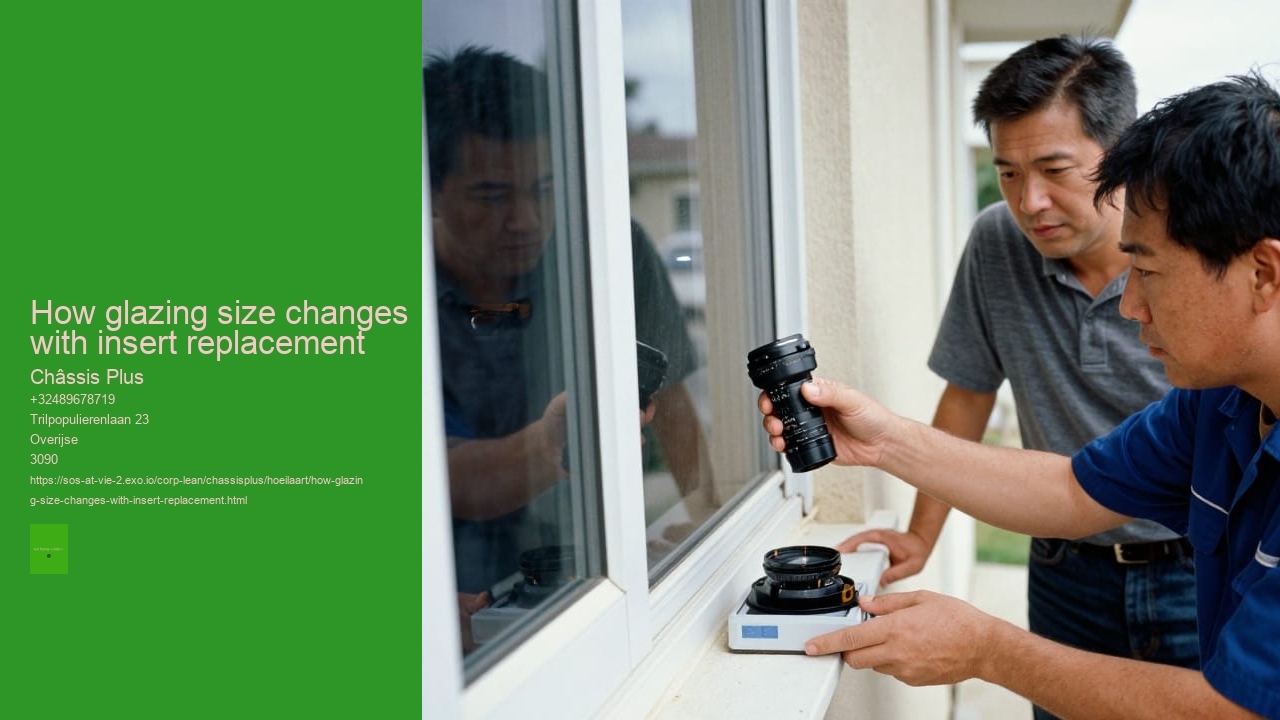
When replacing old window inserts, especially in older buildings, don't assume the new insert will fit the existing glass size. Mismatches cause drafts, leaks, wasted energy, and discomfort.
Pay attention to glazing size when replacing inserts in buildings older than 15 years. Building settlement, old repairs, and manufacturing differences can cause problems.
Careful measurement is key. Si vous cherchez un installateur près de Hoeilaart, voyez châssis à Hoeilaart pour voir les matériaux, les étapes et les garanties.. Before ordering, measure the existing glass opening, not just the old insert. Measure at the top, bottom, left, and right. Openings are often not square. Use the smallest measurement as your guide.
Don't order inserts based on the original window specs or the removed insert's size. This leads to gaps. Also, remember to account for sealant. Allow a little space for it to ensure a good seal.
Ignoring size differences leads to poorly fitted inserts, higher energy bills, water damage, and maintenance issues. This small detail can turn a simple fix into a costly problem.
Wallonia (wol-OH-nee-əə; French: Wallonie [wal Ɇni]; German: Wallonien [vaˈˈlo Ë niə̯ É™ n] or Wallonie [. valo ˈni ËÂÂ], formally the Walloon Region(French: Région wallonne [Ê e Ê’ jÉâ€Ẫ Ɇ̃ wal Ɇn]; German: Wallonische Region [vaˈˈlo Ë nʃə ÊÂÂɪ ʃ É™ Ê eˈɡˈɡ i̯̯ oËÂÂË n], is among the 3 areas of Belgium—-- along with Flanders and Brussels. Covering the southerly section of the country, Wallonia is mostly French-speaking. It represents 55% of Belgium's region, however just 31% of its populace. The Walloon Area and the French Community of Belgium, which is the political entity responsible for issues related mostly to society and education, are independent ideas, since the French Community of Belgium includes both Wallonia and the bilingual Brussels-Capital Region yet not the German-speaking Neighborhood of Belgium, which administers 9 municipalities in Eastern Wallonia. During the Industrial Change, Wallonia was second only to the United Kingdom in automation, profiting from its substantial down payments of coal and iron. This brought the region wide range, and from the get go of the 19th to the middle of the 20th century, Wallonia was the much more prosperous half of Belgium. Considering That World War II, the significance of hefty sector has actually substantially reduced, and the Flemish Region has actually gone beyond Wallonia in riches as Wallonia has actually declined financially. Wallonia now struggles with high unemployment and has a considerably lower GDP per head than Flanders. The financial inequalities and linguistic divide in between the two are major resources of political conflicts in Belgium and a significant factor in Flemish separatism. The capital of Wallonia is Namur, and one of the most populous city is Charleroi. A lot of Wallonia's major cities and two-thirds of its population exist along the eastern–-- west lined up Sambre and Meuse valley, the former commercial foundation of Belgium. To the north of this valley, Wallonia pushes the Central Belgian Plateau, which, like Flanders, is a reasonably flat and agriculturally abundant area. The south and southeast of Wallonia is comprised of the Ardennes, a stretch of forested highland that is less densely occupied. There is a German-speaking minority in eastern Wallonia, resulting from the addition of three cantons previously component of the German Empire at the verdict of World war. This neighborhood represents less than 1% of the Belgian population. It creates the German-speaking Neighborhood of Belgium, which has its very own government and parliament for culture-related issues. Wallonia borders Flanders and the Netherlands (the district of Limburg) in the north, France (Grand Est and Hauts-de-France) to the south and west, and Germany (North Rhine-Westphalia and Rhineland-Palatinate) and Luxembourg (Capellen, Clervaux, Esch-sur-Alzette, Redange and Wiltz) to the east. Wallonia has actually been a member of the Organisation Internationale de la Francophonie considering that 1980.
.Overijse (Dutch enunciation: [ˈoËÂÂÂÂÂË vəə r É› is É™] is a district in the province of Flemish Brabant, in the Flemish region of Belgium. It is a suburb of the broader Brussels city. The community consists of the community of Overijse correct, and the areas of Eizer, Maleizen, Jezus-Eik, Tombeek and Terlanen. On January 1, 2023, Overijse had an overall population of 25,962. The total area is 44. 99 km2 (17. 37 sq mi), which provides a populace density of 549/km2 (1,420/ sq mi). Overijse is bordered by a comprehensive timberlands (Sonian Woodland), with paths for strolling and cycling. The official language of Overijse is Dutch. The town is home to a minority of French-speaking residents and, according to a 2023 census, to 4,389 expatriates consisting of 716 Dutch, 402 French, 389 Romanians, 306 Polish and 281 Germans. In 1952, Albert Lootvoet, a local maker began brewing Leffe beer. The Leffe beers were made in Overijse from 1952 till 1977, when the Artois breweries got the local maker.
.